Opinion and legal analysis • MR 1435 Speaks
Illinois does not merely regulate the exercise of a constitutional right. It requires a resident to apply, identify themselves, pass a state-run records process, and pay before the State will issue the card that generally makes firearm and ammunition possession lawful. Failure to possess the required credential can then become the basis for criminal punishment.
A right that exists only after payment, processing, and government approval is being treated less like a right and more like a licensed privilege.
The origin must come first: application fees and the role they play
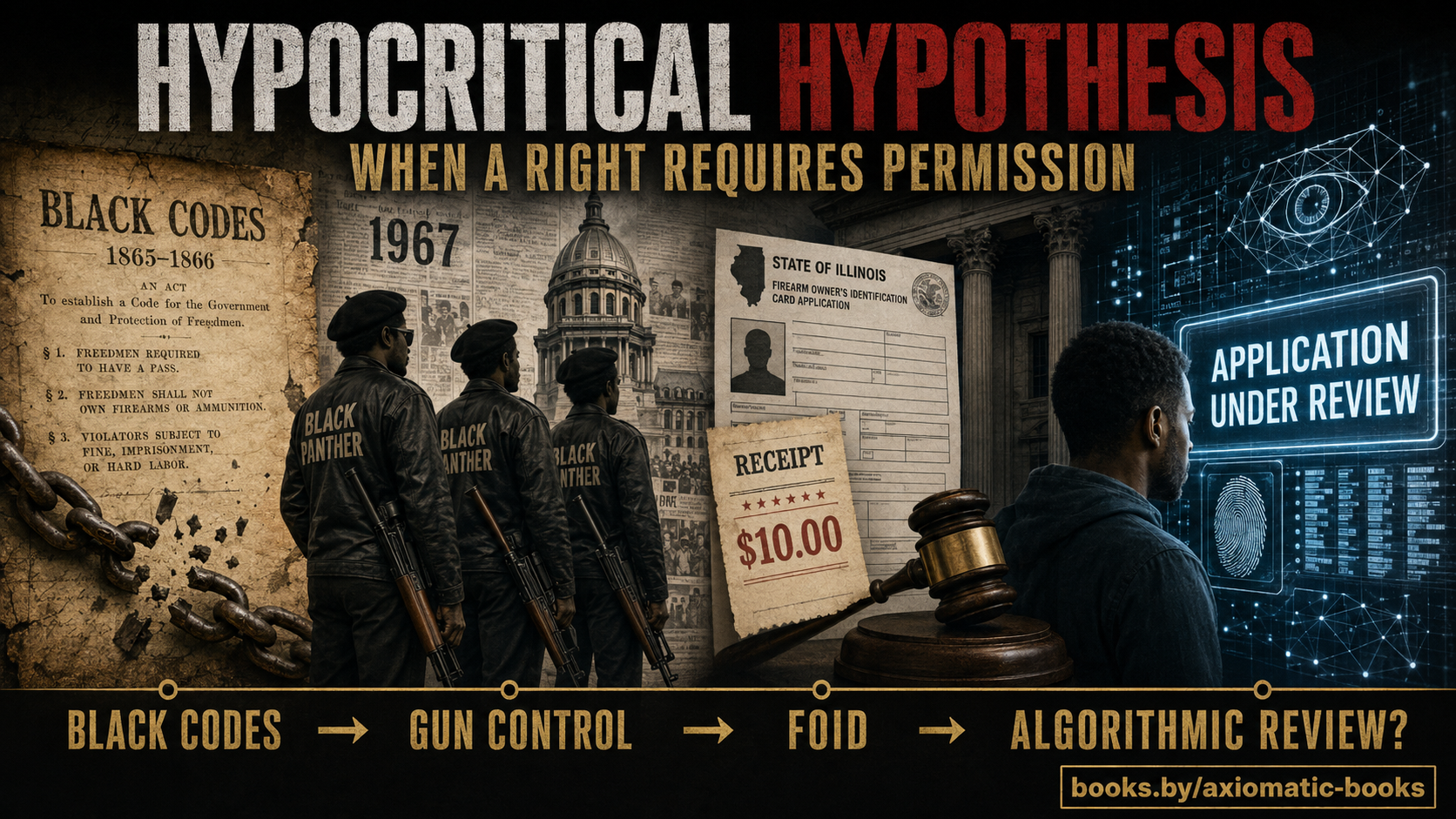
Illinois adopted the Firearm Owners Identification Card system in 1967, and the law took effect in 1968 amid a national period in which lawmakers described firearms legislation in the language of riots and racial unrest. Today, a qualified applicant is generally entitled to a FOID card only after paying a $10 statutory fee plus any authorized electronic-payment processing charge. The Illinois State Police also lists a valid Illinois identification document, a recent photograph, and electronic payment among the prerequisites for applying.
Ten dollars may appear modest. Constitutionally, however, the amount is not the whole question. The fee marks the entrance to the permission system. It funds and legitimizes the administrative machinery that screens the applicant, produces the credential, and can leave a person outside the law if the application is denied, delayed, incorrectly matched, or never filed. Optional fingerprinting and the cost of obtaining records or legal help for an appeal can add burdens beyond the face-value application fee.
Black freedom changed the meaning of gun control
American gun regulation cannot be honestly examined without race. After the Civil War, Black Codes expressly restricted freed Black people from possessing arms. Later laws often became facially neutral while operating through discretionary policing, licensing, and selective enforcement.
The Black Panther Party made the contradiction visible. In California, the Panthers lawfully carried firearms while monitoring police activity in Black neighborhoods. California answered with the 1967 Mulford Act, signed by Governor Ronald Reagan and supported at the time by the National Rifle Association. The statute restricted loaded public carry after the Panthers’ armed activism drew national attention. Whatever one thinks of the Panthers’ tactics, that history demonstrates how quickly a broadly stated gun right could become politically intolerable when Black Americans visibly exercised it.
My hypothesis
My thesis is that modern gun-control systems, and judicial doctrines that excuse or narrow the practical exercise of the Second Amendment, remain connected to the older project of restricting Black access to arms. I do not claim that every present-day legislator, judge, or administrator acts from conscious racial hostility. I argue that a system can inherit a racial function even when its current text is neutral and its present operators deny discriminatory intent.
This is a hypothesis requiring disclosure and measurement. Illinois does not appear to publish a complete, accessible race-by-race table of FOID applications, denials, delays, erroneous matches, appeals, reversals, and criminal enforcement. Without that information, the State cannot fairly demand that the public accept its assurances while withholding the data needed to test disparate impact.
A constitutional right with an admission fee
The FOID Act generally bars an Illinois resident from acquiring or possessing firearms or ammunition without a valid card, subject to statutory exceptions. Illinois then enforces licensing through criminal statutes. The practical sequence is unmistakable: apply, pay, clear the government’s records, receive the credential, and only then exercise the right without exposure to the licensing offense.
Apply and pay→Automated record searches→Issue, delay, or deny→Possession may become criminal
A neutral application form does not guarantee a neutral system. Criminal-history databases reflect unequal policing and prosecution. Identity matching can reproduce naming errors, incomplete dispositions, and stale records. Mental-health and court databases can contain their own reporting gaps. When those systems feed a firearms-eligibility decision, accumulated inequality can be converted into a denial, suspension, revocation, delay, or prosecution.
Paying for the machinery that can criminalize you
The applicant pays the State to run the system, but the applicant does not control the data, the matching logic, the priority rules, or the error-correction process. That structure is especially troubling for people with less disposable income, limited internet access, records spread across jurisdictions, or names more likely to produce false matches. The same person may then have to navigate an administrative record challenge, the FOID Card Review Board, or court proceedings to recover a right the State withheld.
The creation of a paper crime
The system can transform conduct that may be constitutionally protected in substance into a crime because the person lacks the required paper or electronic status. That is the central hypocrisy: the Constitution speaks in the language of a right, while Illinois administration speaks in the language of eligibility, payment, processing, and permission.
Is an algorithm standing between the citizen and the Constitution?
The verified answer is more limited than the question. Illinois law requires the State Police to conduct automated searches of state criminal-history files, FBI and NICS records, and Department of Human Services records relevant to disqualification. The public applicant portal is part of an Equifax-hosted infrastructure: the portal itself displays an Equifax copyright notice. These facts establish an automated, vendor-involved pipeline. They do not, by themselves, prove that artificial intelligence makes the final decision to approve or deny a FOID application.
Equifax is inside the infrastructure
Equifax’s visible role matters because a private technology company is operating within the front end of a state constitutional-rights process. The State should disclose the company’s precise contractual role: hosting, identity proofing, fraud detection, workflow automation, data matching, decision support, or some combination. It should also disclose which tools are deterministic rules, which use statistical models, and which—if any—qualify as artificial intelligence.
ISP has authorized secure AI
Illinois State Police Directive SRV-230, effective June 2, 2025, authorizes secure AI for uses that include analyzing ISP data and review-board findings, searching databases and records, improving database and operating-system automation, and enabling public-facing chatbots. The directive defines AI broadly to include machine learning, algorithmic decision support, pattern recognition, anomaly detection, and large language models. It also requires human oversight and validation of official work products using AI.
The directive proves that ISP permits secure AI in categories broad enough to touch records and review functions. It still does not establish that FOID applications are presently scored, recommended, or adjudicated by AI. That unanswered question belongs in public records, procurement documents, algorithmic-impact assessments, and sworn testimony—not in speculation presented as fact.
Automated error becomes constitutional injury
In an ordinary consumer transaction, a bad automated match can cause inconvenience or financial loss. In the FOID system, the same type of error can block a constitutional right and help define later possession as unlawful. Human review after the fact is not an adequate answer if the person first bears delay, cost, stigma, surrender demands, or criminal exposure.
From economic exclusion to racial criminalization
The racial-impact claim must be tested at every stage, not reduced to a single denial percentage. Who abandons the application because of cost or digital barriers? Who is delayed by identity verification? Who is falsely matched to a prohibiting record? Who can afford counsel or obtain certified dispositions? Whose appeal succeeds, and how long did success take? Who is arrested or prosecuted for possession without valid FOID status?
Black Illinoisans are disproportionately exposed to parts of the criminal-justice system that populate the databases later queried by licensing systems. That reality does not, standing alone, prove that FOID officials discriminate. It does establish why a race-blind audit is inadequate and why the burden belongs on the State to publish outcomes and error rates by race, geography, income proxy, and decision stage.
The judicial excusal of rights
Courts often protect licensing systems by calling them “shall issue,” emphasizing stated eligibility rules, or resolving challenges on standing, mootness, or procedural grounds. Those doctrines may be legally orthodox, but their cumulative effect can be to avoid the lived question: how much delay, cost, error, and criminal exposure may the State place between an ordinary person and a constitutional right?
In Bright v. Yenchko, the Illinois Supreme Court did not issue a statewide merits ruling on the challenged FOID suspension provision. On May 21, 2026, it held the dispute moot after Bright’s card had been reinstated and vacated the circuit court’s constitutional judgment. So the case did not dismantle the statewide FOID system.
It is no longer accurate, however, to say that no Illinois licensing challenge has reached the U.S. Supreme Court. In Thompson v. Illinois, a petition challenged criminal enforcement of Illinois’s dual FOID-and-concealed-carry licensing regime. The Supreme Court docketed the petition as No. 25-6425 and denied certiorari on February 23, 2026. A denial of certiorari is not a merits ruling endorsing the system, but it ended that route without full Supreme Court review.
What Illinois must disclose
Outcomes: Applications, approvals, denials, delays, revocations, reversals, and abandonment rates, disaggregated by race and geography.
Errors: False matches, stale records, corrected records, average correction time, and harm occurring before correction.
Automation: Every rules engine, model, score, flag, queue, and recommendation used from application through appeal.
Vendors: Equifax’s contract, subcontractors, data sources, retention rules, audits, and performance measures.
Human review: Which decisions require a person, what evidence reviewers see, and whether they may override automated results.
Enforcement: Arrests, charges, dispositions, and sentences tied to missing, expired, denied, suspended, or revoked FOID status.
The hypocrisy
Government calls firearm ownership a constitutional right, charges an admission fee, routes the citizen through opaque data systems, criminalizes noncompliance, and then asks the person harmed by the system to prove that the system is unfair.
My hypothesis is not that every gun law has the same text, motive, or effect. It is that American gun control repeatedly becomes most politically acceptable when it limits the arms of Black people, poor people, and other communities already subject to heavier surveillance. Courts excuse the machinery one procedural decision at a time, while the State withholds the measurements that would reveal who is actually excluded.
Conclusion
Illinois should not be permitted to hide a constitutional gate behind the word “administration.” If the State insists that residents pay for permission before lawfully possessing firearms, it must prove—publicly and continuously—that the system is accurate, prompt, reviewable, racially equitable, and never controlled by an undisclosed algorithm. Until then, the FOID card remains more than identification. It is the government’s switch between a constitutional right and a criminal offense.
Editorial safeguard: This is an opinion and legal-analysis thesis, not a finding that Illinois intentionally discriminates or that AI presently makes final FOID decisions. Publicly available sources reviewed for this article did not provide a complete race-disaggregated FOID application dataset. The article identifies that absence as a disclosure and audit problem. Legal status is current through August 1, 2026.